White Gloves
New Life as a Max Level ArchmageThe White Gloves are the world’s elite bodyguarding service: an organization of highly trained servants whose refinement, hierarchy, and combat power make them far more than household attendants. Their decisive significance lies in the way they convert Vivisari Vexaria’s former manor into a living institution of inherited loyalty. By the time Vivisari Vexaria returns, the organization has become strong enough to challenge a powerful intruder, yet disciplined enough to treat discretion as a foundational virtue.
Foundation and Institutional Identity
The White Gloves were founded by Winston in the century after Vivisari Vexaria disappeared. In her absence, he repurposed her manor into the Academy for the Domestic Arts and Establishment of Excellent Service, a training academy for the world’s most elite bodyguarding service. The institution therefore joins two forms of labor that are often kept separate: domestic service and military-grade protection. Its servants carry themselves with the dignity associated with royalty, while their abilities place them on equal footing with some of the best adventurers in the world.
The academy’s structure is visibly hierarchical. Rank is displayed through metal bars on the lapels of its uniforms: one gold bar marks a Glove of the Second Class, while two silver bars identify the lower-ranked White Gloves seen by Vivisari Vexaria. The uniforms are sufficiently similar across the estate to suggest a unified institutional code rather than ordinary household clothing. The academy also trains students who have not yet graduated. Their age and less polished bearing distinguish them from the older servants, while their lessons are conducted by instructors who are themselves White Gloves of the Second Class or higher.
This arrangement makes the academy both school and fortified household. Its defenses include enchantments laid by Vivisari Vexaria herself, and those wards repel intruders who lack explicit permission to enter. An unauthorized person who bypasses them is consequently treated not as a harmless visitor but as a credible threat. The White Gloves’ institutional identity is thus built upon a fusion of ceremony, surveillance, education, and immediate force.
Combat Capacity and the Academy Confrontation
The organization’s power becomes unmistakable when Vivisari Vexaria returns to the manor while concealing her identity. A senior White Glove, Constance, serves as Deputy Headmistress and is a First Class Glove with Titled-rank status. Her position gives her formidable combat ability, and the academy’s defensive imperative further strengthens its personnel when the grounds and students are threatened.
The confrontation begins because Vivisari Vexaria has entered without an invitation and without being recognized as the manor’s original owner. Constance interprets the breach of the wards as evidence that the intruder is exceptionally dangerous and shifts from formal poise into a stable fighting stance. From the academy’s perspective, the response is institutionally rational even though the conclusion is mistaken: an unknown demon-mage has penetrated defenses created by the Sorceress herself and appears capable of threatening the students.
The White Gloves’ combat system is not merely symbolic. Nicole, a student nearing graduation, has already surpassed the level adventurers call mithril rank, or level six hundred. When the academy faces imminent danger, her shared class skill, [In Active Service], activates and grants her the speed, strength, and perception of someone two hundred levels higher, placing her temporarily at orichalcum-rank power. The academy’s training therefore creates a reserve of defenders whose ordinary status as students conceals their battlefield potential.
Constance is soon joined by four additional White Gloves. A woman with blonde pigtails attacks with twin daggers, a butler enters with a black steel rapier, and two more Gloved combatants follow. Vivisari Vexaria consequently faces five White Gloves at once, with even the weakest newcomer wielding Titled-level strength. The battle damages more and more of the yard, but the numerical advantage never becomes a genuine threat. Even five Gloved defenders of the Second Class or higher, working in concert, cannot force Vivisari Vexaria to abandon her impassive expression; Constance realizes that the supposed monster has been testing them rather than fighting seriously.
The scene reveals the White Gloves’ strength while also defining its limit. Their training, ranks, emergency enhancement, and coordinated defense make them extraordinarily dangerous by ordinary standards. Against Vivisari Vexaria, however, their power is radically outmatched. The organization’s defenders mistake restraint for vulnerability because they cannot recognize the person whose legacy they are protecting.
Discipline, Secrecy, and Social Performance
The White Gloves’ strength is inseparable from their code of conduct. Their service is performed through visible discipline: controlled posture, formal uniforms, polished manners, and strict attention to rank. Even the senior women carry themselves with a dignity likened to servants of royalty. Such behavior is not decorative. It is part of the organization’s authority, allowing a household attendant to appear simultaneously deferential and untouchable.
That public performance can conceal enormous force. The academy’s students appear young and surprised when they watch the confrontation, while the older instructors retain a statue-like composure even as they assess the threat. Nicole’s decision to observe rather than interfere illustrates the organization’s balance between decorum and practical judgment. Watching an unprecedented breach is not treated as a lapse in manners when the safety of the academy is at stake.
Secrecy is equally central. After revealing herself to Winston, Vivisari Vexaria asks him to keep her presence quiet because she intends to maintain a low profile. Winston answers that discretion is a fundamental virtue of any servant and believes the students will remain silent, although he admits that he cannot guarantee that no one will speak. The exchange confirms that confidentiality is not an improvised favor but an institutional principle. The White Gloves protect not only bodies and estates, but also information and identity.
The organization’s formal courtesy also exposes class tensions beyond the academy. During the journey in which Vivisari Vexaria and Saffra travel as gold- and silver-rank adventurers, a nobleman comments on their “unconventional company” while fishing for information about how they obtained Lounge tickets. His son later demands that Saffra explain who they are and how they afforded access. The encounter shows the same social world that values rank, appearance, and controlled access—the White Gloves’ world, though the organization’s discipline is more substantial than aristocratic snobbery. Its service etiquette is not simply a performance of superiority; it is a practiced system attached to protection, responsibility, and skill.
Winston’s Legacy and Vivisari Vexaria’s Return
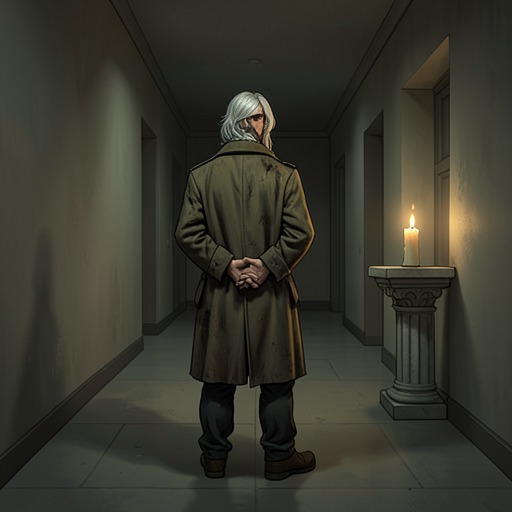
Winston is the bridge between the White Gloves and Vivisari Vexaria. When she dispels the illusion concealing her face, she finds that he has aged from the refined man in his thirties whom she remembers from the game into a silver-haired man who appears to be in his late fifties. The passage of a century has altered his body, but not his devotion. His students, academy, and servants demonstrate that he used the long interval not to preserve a memory passively, but to build an institution from it.
Vivisari Vexaria’s response is complicated by guilt and surprise. She had intended to remain incognito, and she recognizes that the White Gloves attacked first only because she had bypassed the manor’s defenses. She also acknowledges that she could have ended the fight immediately but prolonged it because the chance to test a Titled-rank combat maid appealed to her. When she turns to Winston, she braces for a deserved scolding rather than claiming automatic obedience from the people who once served her.
Her request for secrecy establishes a renewed but altered relationship. Winston still addresses her as his mistress, and the academy’s existence confirms that he has preserved the authority associated with her name. Yet Vivisari Vexaria now understands that she is not simply returning to an unchanged household. She is entering an institution shaped by Winston and inhabited by generations of students and servants who know the Sorceress primarily as the founder of their legacy.
The White Gloves also provide a network through which older relationships re-emerge. Rafael tells Vivisari Vexaria that he has brought Mae to her, and Mae identifies herself as the former alchemist of Jasper’s team. Mae hesitates as though wanting to touch Vivisari Vexaria to prove that she is real, then restrains herself and says that she thought she would never see her again. This reunion parallels Winston’s: Vivisari Vexaria returns to a world in which loyalty has continued through absence, though it has been reshaped by time and uncertainty.
Narrative Role and Significance
The White Gloves function as both organization and institutional memory. Their academy gives physical form to the consequences of Vivisari Vexaria’s disappearance: her manor is no longer merely a private residence but the headquarters of a renowned service tradition. Their uniforms, ranks, students, and defensive enchantments make history visible in the present.
They also dramatize the contrast between appearance and capacity. A maid’s composed posture, a lapel’s small metal bars, and a servant’s promise of discretion conceal powers that can reach Titled or even temporarily orichalcum levels. Conversely, the White Gloves’ greatest misjudgment occurs because their careful systems cannot immediately recognize their founder. Vivisari Vexaria appears as an unknown demon-mage precisely because her own protective legacy has become independent of her physical presence.
Their significance therefore rests on inheritance rather than mere combat spectacle. Winston has preserved the habits of service while expanding them into education, hierarchy, and collective defense. The White Gloves protect the academy with violence when necessary, but they define themselves through restraint, loyalty, and secrecy. They are the most concrete proof that Vivisari Vexaria’s influence survived her absence—and that what survives a founder may become more disciplined, more formidable, and less personally recognizable than the legacy from which it began.